

When Houston homeowners face financial hardship—whether from job loss, medical expenses, or the lingering impacts of Hurricane Harvey—the possibility of foreclosure can feel overwhelming. Understanding whether a short sale is the right option for your home requires evaluating your specific financial situation and knowing your alternatives. In Houston’s dynamic real estate market, where property taxes average 2.53% (well above the state’s 1.80% average) and flood zone reclassifications continue to affect property values, a short sale can provide a path forward that protects your financial future while avoiding the devastating credit impact of foreclosure. In this blog post, Houston real estate expert Chris Schmidt discusses the top 5 signs a short sale is the right option for your home, explaining the specific considerations for homeowners in Harris County and throughout the Greater Houston area.
Key Takeaways
- Financial hardship combined with negative equity creates the primary scenario where a short sale becomes necessary
- Short sales can preserve significantly more of your credit score compared to foreclosure (100-150 point drop vs. 250-300 points)
- The Houston short sale process typically takes 3-6 months, requiring patience and expert guidance to navigate lender approval
- Texas deficiency judgment laws differ from other states—understanding your rights is critical before proceeding
A short sale may be the right option for your Houston home if you’re facing foreclosure, owe more than your home’s current value, cannot afford monthly payments due to financial hardship, have exhausted loan modification options, or need to avoid the severe credit damage of foreclosure.
To Discuss Your Home Sale or Purchase, Call or Text Today and Start Packing!
Chris Schmidt has guided hundreds of Houston families through the short sale process over nearly two decades, developing specialized expertise in navigating complex lender negotiations and Harris County-specific procedures. His team’s comprehensive understanding of Texas deficiency judgment laws, post-Harvey flood zone impacts, and local market conditions enables him to provide Houston homeowners with strategic guidance that protects their financial future.
What Is a Short Sale? Understanding Your Options in Houston
A short sale occurs when a Houston homeowner sells their property for less than the remaining mortgage balance, with the lender’s approval. Unlike foreclosure, which is a forced sale initiated by the lender, a short sale allows the homeowner to maintain control of the process and timing. This distinction is crucial for homeowners facing financial difficulty, as it provides options that foreclosure simply cannot offer.
In Texas, short sales operate under specific legal frameworks that differ from other states. The Texas Property Code provides certain protections for homeowners, but Texas is also a “recourse” state, meaning lenders can potentially pursue deficiency judgments for the difference between what you owe and what the property sells for. However, most short sale negotiations include deficiency waivers that protect homeowners from future liability. Consequently, working with an experienced agent who understands these nuances becomes essential.
Houston’s real estate market has unique characteristics that make short sales increasingly common. Post-Harvey property value impacts, Harris County’s accelerated foreclosure timeline (21 days from acceleration notice—the fastest in the nation), and the region’s energy-sector employment volatility all contribute to situations where homeowners need alternatives to traditional sales or foreclosure. Furthermore, working with an experienced agent familiar with these local factors is essential for navigating this complex process successfully.
Short Sale vs. Foreclosure: Key Differences in Texas
Understanding the differences between a short sale and foreclosure in Harris County helps homeowners make informed decisions. Therefore, examining these distinctions reveals why many Houston homeowners choose the short sale path when facing financial hardship.
Credit Score Impact:
– Short Sale: 100-150 point drop, remains on credit report for 7 years
– Foreclosure: 250-300 point drop, remains on credit report for 7 years
Future Home Buying Eligibility:
– Short Sale: FHA loans available after 3 years; Conventional loans after 4 years
– Foreclosure: FHA loans after 3-7 years (depending on circumstances); Conventional loans after 7 years
Control of Process:
– Short Sale: Homeowner maintains control, chooses listing agent, approves offers
– Foreclosure: Lender controls everything, homeowner has no input
Deficiency Judgment Risk:
– Short Sale: Typically includes negotiated waiver (5% enforcement rate)
– Foreclosure: Higher enforcement risk (approximately 15% in Harris County)
Timeline:
– Short Sale: 3-6 months from listing to closing
– Foreclosure: 21 days from acceleration notice in Texas
Short Sale vs. Foreclosure
Texas-Specific Comparison for Harris County Homeowners
| Decision Factor | Short Sale | Foreclosure |
|---|---|---|
| Credit Impact | 100-150 Pt Drop | 250-300 Pt Drop |
| TX Timeline | 3–6 Months | ~21 Days (Non-Judicial) |
| Deficiency Risk | Typically Waived | Higher Risk |
Frequently Asked Questions
Which is better for my credit score?
How fast is the foreclosure process in Texas?
“The biggest misconception Houston homeowners have is that foreclosure is inevitable once they fall behind on payments. In reality, a short sale gives you control of the process and can preserve your credit score in ways that foreclosure simply cannot. I’ve helped families throughout Houston avoid foreclosure and move forward with dignity.” – Chris Schmidt
Sign #1: You Owe More Than Your Houston Home Is Worth (Negative Equity)
You’re underwater when your mortgage balance exceeds your home’s current market value—a situation affecting thousands of Houston homeowners, particularly in neighborhoods impacted by Hurricane Harvey’s flood zone reclassifications. Negative equity is the fundamental requirement for a short sale, as it means you cannot sell your home through traditional means without bringing significant cash to the closing table. Therefore, understanding whether you have negative equity is the first step in determining if a short sale is appropriate.
Post-Harvey FEMA flood map updates implemented between 2018 and 2024 resulted in insurance premium increases of 30-60% for homes in newly-designated Special Flood Hazard Areas. These changes depressed property values in affected neighborhoods like portions of Kingwood, west Houston near Buffalo Bayou, and areas along Cypress Creek. Additionally, some homeowners who purchased near the market peak in 2014-2015 have found their home values declining while their mortgage balances remain high, creating underwater situations even without flood zone impacts.
For example, if you owe $350,000 on your mortgage but your home’s current value (due to flood zone reclassification and required flood insurance) has dropped to $280,000, you have $70,000 in negative equity. This makes a traditional sale in Houston impossible without bringing cash to closing. Moreover, many homeowners don’t have $70,000 in savings available, making a short sale the only viable path forward besides foreclosure.
How to Determine Your Houston Home’s Current Market Value
Several factors determine your Houston home’s current market value, and understanding these helps you assess whether you’re truly underwater. Consequently, getting an accurate valuation is essential before pursuing any alternatives to foreclosure.
- Harris County Appraisal District (HCAD) Assessment: Your HCAD assessed value provides a baseline, but market value often differs from assessed value, especially in rapidly changing neighborhoods
- Recent Comparable Sales: Properties sold within the last 3-6 months in your neighborhood provide the most accurate market value indicators
- Post-Harvey Adjustments: Homes in newly-designated flood zones typically see 8-15% value reductions due to increased insurance costs
- Professional Valuation: A professional home valuation from a Houston-area agent provides the most accurate assessment
The best realtor in Houston will analyze all these factors to determine whether your home qualifies for a short sale based on negative equity. Chris Schmidt’s team regularly conducts comprehensive market analyses for homeowners throughout The Woodlands, Katy, and Houston’s inner loop neighborhoods to provide accurate valuations.
Sign #2: Your Property Taxes Have Become Unaffordable (Harris County-Specific)
Harris County homeowners face one of the highest property tax burdens in the United States, with an effective tax rate of 2.53%—significantly above the Texas state average of 1.80% and the national average of 1.07%. This substantial tax burden means a home valued at $300,000 generates annual property taxes of approximately $7,590, or $632.50 per month. When combined with mortgage principal, interest, and insurance, these high taxes push many Houston homeowners beyond their affordable housing payment threshold.
For Houston homeowners in MUD (Municipal Utility District) areas—common in newer suburbs like Bridgeland, Elyson, and Jordan Ranch—additional tax rates of 0.2% to 0.8% can push total property tax bills even higher. When combined with HOA fees ranging from $50-$300 monthly and rising insurance costs (especially for flood-prone properties), monthly housing costs can become unsustainable. Subsequently, homeowners find themselves spending 40-50% of gross income on housing, well above the recommended 28-31% threshold.
If rising property taxes have pushed your monthly payment beyond 31% of your gross income, you may qualify for a short sale based on financial hardship—even if other factors like job loss aren’t present. The HCAD homestead exemption increased to $100,000 in 2024, providing some relief, but homeowners who purchased before this increase still face substantial tax bills. Furthermore, Harris County property values increased 15-20% in many neighborhoods between 2020 and 2024, causing corresponding tax bill increases that strain household budgets.
Harris County Tax Impact Guide
Estimated monthly impact based on standard 2.53% tax rates.
~$421 per month
~$632 per month
Harris County Property Tax Payment Options vs. Short Sale
Before pursuing a short sale due to property tax burden, Houston homeowners should explore alternative options. Nevertheless, if these alternatives still leave monthly payments unaffordable, a short sale becomes necessary.
- HCAD Payment Plans: Harris County offers installment payment plans for property taxes if you apply by January 31st, allowing you to spread payments over 12 months
- Property Value Protest: If you believe your home is over-assessed, filing a protest with HCAD (deadline typically May 15th) can reduce your tax burden
- Homestead Exemption: Ensure you’ve filed for the $100,000 homestead exemption if your property is your primary residence
- Tax Deferral (65+): Homeowners 65 or older can defer property taxes until the home is sold
However, if these options still leave your monthly housing payment unaffordable, a short sale becomes a more strategic choice than continuing to struggle with payments you cannot sustain. Chris Schmidt’s team helps Houston homeowners evaluate all alternatives before recommending the short sale path.
Sign #3: You’re Facing Financial Hardship That Won’t Improve
Lenders approve short sales when homeowners demonstrate genuine financial hardship that prevents them from maintaining mortgage payments. Qualifying situations include job loss, reduced income, divorce, medical expenses, business failure, or job relocation. The key factor is that the hardship must be significant enough that you cannot reasonably maintain your mortgage obligations, even with loan modification or payment plan assistance.
In Houston’s energy-sector-dependent economy, oil price fluctuations can trigger waves of layoffs in the Energy Corridor, Greenspoint, and other corporate employment centers. When crude oil prices dropped below $40 per barrel in 2020, Houston experienced significant job losses that made mortgage payments unaffordable for thousands of homeowners. Similarly, the 2014-2016 oil downturn resulted in widespread short sales throughout Houston as energy sector workers lost high-paying positions with limited local alternatives in their specialized fields.
Houston-area lenders require a hardship letter explaining your situation, along with supporting documentation. This typically includes recent pay stubs (or termination notice), bank statements showing insufficient reserves (usually less than 2-3 months of mortgage payments), tax returns demonstrating income decline, and medical bills if applicable. Additionally, lenders want to see that you’ve exhausted savings and retirement accounts (though they don’t require complete depletion). The documentation proves your hardship is genuine and not strategic default to escape an underwater mortgage.
Temporary vs. Permanent Hardship: When Short Sale Makes Sense
Not every financial hardship warrants a short sale. Understanding the distinction between temporary and permanent hardship helps determine the right path forward for your specific situation.
Temporary Hardship Scenarios (Loan Modification May Be Better):
– Short-term medical leave with expected return to work
– Temporary income reduction with recovery timeline under 6 months
– Seasonal employment gaps with predictable future income
– Recent job loss with strong local job market in your field
Permanent Hardship Scenarios (Short Sale Often Best Option):
– Job loss in declining industry with no comparable local opportunities (e.g., oil and gas sector downturn)
– Permanent disability preventing return to previous income level
– Divorce resulting in insufficient single income to maintain mortgage
– Business failure with no immediate income replacement
If your position was eliminated at a major Energy Corridor employer like BP, Shell, or Halliburton with no comparable local opportunities in Houston’s current market, a short sale may provide a cleaner exit than struggling for years trying to maintain unaffordable payments. Chris Schmidt has worked with hundreds of families in exactly this situation throughout Greater Houston, helping them transition to more affordable housing while preserving as much credit score as possible.
Sign #4: You’ve Exhausted Loan Modification and Payment Plan Options
Before pursuing a short sale, Houston homeowners should attempt a loan modification with their lender. Modifications can reduce interest rates, extend loan terms (from 30 years to 40 years), or add missed payments to the end of the loan—potentially making the mortgage affordable again. Federal programs like HAMP (Home Affordable Modification Program) and Making Home Affordable (MHA) have helped thousands of Texas homeowners avoid foreclosure through modified loan terms.
However, loan modifications are not guaranteed, and many applications are denied. Lenders may reject modifications if your income is too low to support even a reduced payment, if you don’t qualify under federal program guidelines, or if your property is too far underwater (typically more than 125% loan-to-value ratio). In Houston’s high-property-tax environment, even a reduced mortgage interest rate may not lower monthly payments enough when taxes continue increasing year over year.
If your lender denies your modification request—or if you complete a trial modification but still cannot afford the payments—a short sale becomes the next logical step. Many Houston homeowners find that after 3-6 months of attempting modifications, dealing with bureaucratic delays, and providing extensive documentation, a short sale is the only realistic alternative to foreclosure. Moreover, the time spent attempting modification gives you valuable months to plan your next housing move and explore Houston real estate options that better fit your budget.
Houston-Area Lender Modification vs. Short Sale Response Timelines
Different lenders serving the Houston market have varying approval timelines and approval rates. Consequently, understanding these differences helps you set realistic expectations for your timeline.
- Wells Fargo: Modification review typically 90-120 days; short sale approval 6-8 weeks once buyer identified
- Bank of America: Modification review 90-150 days; short sale approval 8-10 weeks
- Chase: Modification review 60-90 days; short sale approval 6-8 weeks
- Local Credit Unions (e.g., First Community Credit Union, Houston Federal Credit Union): Faster modification review (60-90 days); quicker short sale approval (4-6 weeks)
Understanding these timelines helps Houston homeowners plan strategically. If you’re approaching the Harris County foreclosure acceleration timeline (21 days), you may not have time to complete a full modification review before foreclosure proceedings begin.
“I always advise Houston homeowners to try for a loan modification before considering a short sale. But if your lender denies the modification—and many do—a short sale can be arranged relatively quickly. The key is working with an experienced Houston real estate agent who understands lender negotiation strategies and can expedite the approval process.” – Chris Schmidt
Sign #5: You Want to Avoid Foreclosure’s Devastating Credit Impact
A short sale typically causes a credit score drop of 100-150 points and remains on your credit report for seven years. By contrast, foreclosure causes a drop of 250-300 points and also remains for seven years—but the more severe drop makes credit recovery significantly harder. This difference means a Houston homeowner with a 720 credit score before short sale would drop to approximately 570-620, while foreclosure would drop the same homeowner to 420-470 (subprime territory).
FHA loans require a 3-year waiting period after a short sale, compared to 3 years after foreclosure only if extenuating circumstances are documented (otherwise 7 years). Conventional loans require a 4-year wait after short sale but 7 years after foreclosure. For Houston homeowners hoping to purchase again in neighborhoods like The Woodlands, Memorial, or Houston‘s inner loop, short sale’s shorter waiting period is critical. This means you could potentially purchase a home again by 2028-2029 with a short sale completed in 2025, versus waiting until 2032 after foreclosure.
Unlike some states where mortgage debt is “non-recourse,” Texas allows lenders to pursue deficiency judgments—the difference between what you owe and what the property sells for in foreclosure. However, short sale agreements typically include deficiency waivers (negotiated by your agent), while foreclosure deficiency judgments are more common. Chris Schmidt’s team prioritizes negotiating full deficiency waivers in every Houston short sale, protecting clients from future liability even years after the transaction closes.
Understanding Deficiency Judgment Risk in Harris County
Texas Property Code Section 51.003 allows lenders to pursue deficiency judgments after foreclosure, but several factors affect enforcement. Consequently, understanding these factors helps you assess your risk appropriately.
- Statute of Limitations: Lenders have 4 years to pursue deficiency judgments in Texas
- Enforcement Rates: Approximately 15% of Harris County foreclosure cases result in deficiency judgment attempts; less than 5% of short sale cases where waivers were negotiated upfront
- Collection Challenges: Even with a judgment, collecting from a homeowner who has already lost their home is difficult and expensive
- Short Sale Protection: Written deficiency waivers in short sale approval letters provide legal protection against future claims
Recent Harris County court cases have shown that lenders pursue deficiency judgments more aggressively on properties with large deficiency amounts (over $100,000) and when homeowners have attachable assets like high incomes or business interests. For most Houston homeowners facing genuine hardship, deficiency risk is low, especially with proper negotiation during the short sale process.
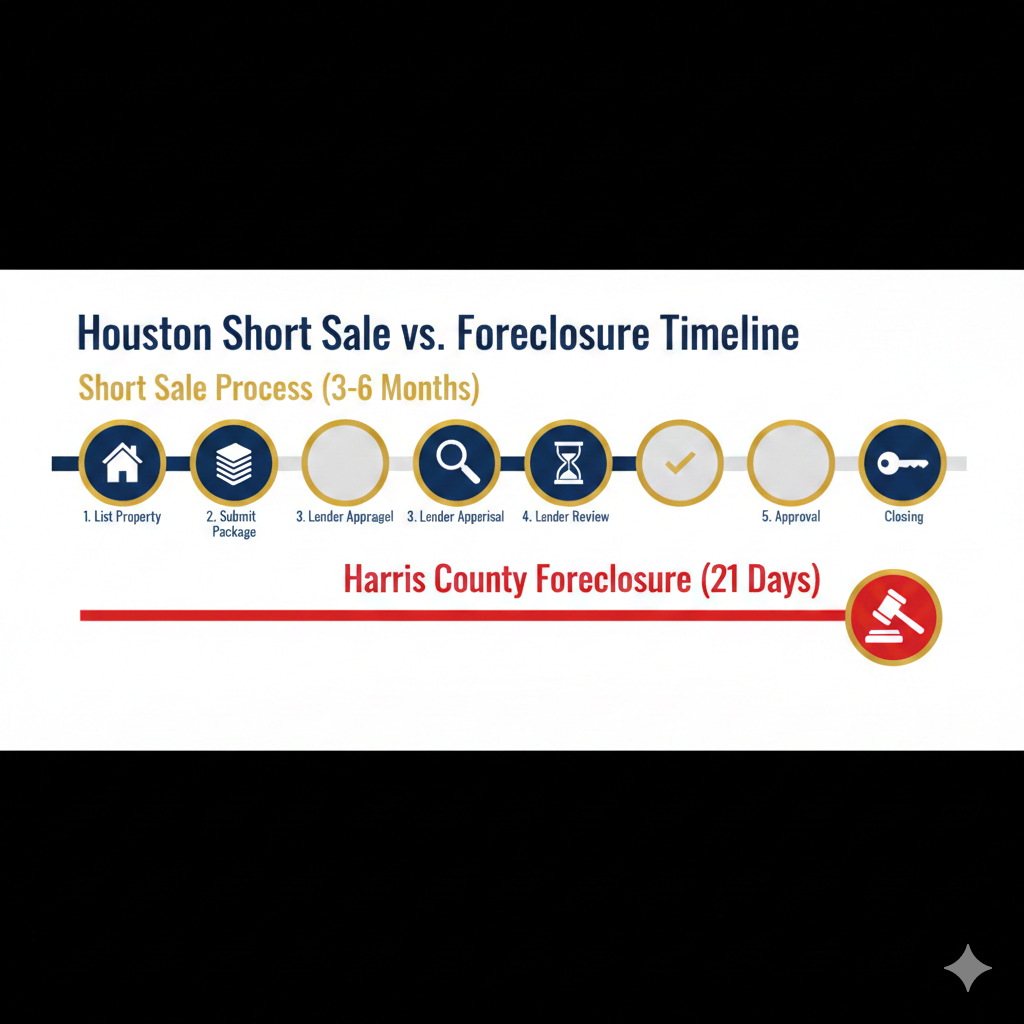
Houston Short Sale Timeline
Average progression for Harris County bank approvals.
Understanding the Houston Short Sale Timeline and Process
Most short sales in Houston take 3-6 months from initial listing to final closing, though the timeline varies based on lender responsiveness, property condition, and market activity. This is significantly longer than a traditional home sale in Houston, which typically closes in 30-45 days, but much faster than the credit recovery time after foreclosure. Understanding this timeline helps Houston homeowners plan their next housing move and set realistic expectations.
The Houston short sale process follows six distinct phases. First, the homeowner lists the property with an experienced short sale agent who prices it competitively to attract buyers quickly (typically 1-4 weeks to receive offers in active Houston neighborhoods). Second, once a buyer’s offer is accepted, the seller compiles a comprehensive hardship package including financial statements, hardship letter, pay stubs, bank statements, and tax returns (1-2 weeks to gather documentation).
Third, the lender orders a Broker Price Opinion (BPO) or full appraisal to verify the property’s value and confirm it qualifies for short sale (2-4 weeks for completion). Fourth, the lender’s loss mitigation department reviews the complete package, which represents the longest phase of the process (4-8 weeks for major banks, sometimes 10+ weeks during high-volume periods). Fifth, once approved, the closing is coordinated between buyer, seller, lender, and title company (2-3 weeks). Finally, the transaction closes similar to a traditional sale (1 day).
Houston-area lender variations significantly impact timeline. Based on Chris Schmidt’s experience with hundreds of Houston short sales, Wells Fargo typically responds in 6-8 weeks, Bank of America in 8-10 weeks, and smaller local lenders like Frost Bank often respond faster (4-6 weeks) due to less bureaucracy. Some lenders have dedicated Houston-area loss mitigation teams that understand local market conditions and process approvals more efficiently.
Why Harris County’s Fast Foreclosure Timeline Matters
Texas has the fastest foreclosure process in the United States, with only 21 days from acceleration notice to foreclosure sale. This makes timing absolutely critical for Houston homeowners considering a short sale. Unlike states like Florida (120+ days) or New York (445+ days), Texas’s accelerated foreclosure timeline means Houston homeowners must act quickly once they fall behind on payments.
If you receive an acceleration letter (also called a Notice of Default), you have approximately 60-90 days before the foreclosure sale, depending on how quickly your lender moves through the process. This compressed timeline means you should start the short sale process as soon as you realize you cannot maintain payments—ideally before receiving any foreclosure notices. Waiting until you’re 60-90 days behind significantly reduces your options and creates unnecessary stress.
Why Choose Chris Schmidt to Navigate Your Houston Short Sale
When you need to avoid foreclosure and protect your financial future through a short sale, working with a Houston real estate professional with specialized short sale expertise makes all the difference. The Chris Schmidt Team at Your Home Sold Guaranteed Realty - Chris Schmidt Team has developed specific systems for successfully navigating complex lender negotiations, Harris County procedures, and Texas deficiency judgment laws that generic real estate agents simply don’t understand.

Chris Schmidt‘s nearly two decades of Houston experience includes guiding hundreds of families through the short sale process. His team’s comprehensive knowledge of post-Harvey flood zone impacts, energy sector employment patterns, and Harris County’s unique foreclosure timeline enables them to provide Houston homeowners with strategic guidance that protects their financial future. With specialized expertise negotiating short sales even in challenging scenarios—including properties with multiple liens, HOA complications, and underwater mortgages exceeding 150% of current value—Chris brings the local knowledge essential for this stressful process.
Success You Can Count On
The team’s track record of successfully selling homes 7 times faster than the market average, achieving 100% of asking price, and maintaining a database of 5,838+ pre-qualified buyers means your short sale property receives maximum exposure to motivated purchasers. This speed is critical given Harris County’s 21-day foreclosure timeline and the typical 3-6 month short sale approval process. Additionally, Chris Schmidt’s team handles all lender communication, documentation submission, and deficiency waiver negotiation, removing the burden from homeowners during an already difficult time.
With hundreds of 5-Star Google reviews from satisfied clients and a reputation built on treating every Houston family with dignity and respect, Houston real estate expert Chris Schmidt understands that short sale clients are facing genuine hardship—not strategic default. His empathetic, professional approach combined with aggressive lender negotiation creates the perfect balance of support and results. The team’s commitment to Houston extends beyond real estate, with a portion of every transaction supporting Friends For Life Animal Shelter as part of their “Go Serve Big” philosophy.
Ready to explore whether a short sale is right for your Houston home? Contact us today at 713-322-5604 for a confidential consultation.
Follow Us on Social Media
Follow Chris Schmidt Team on social media for the latest Houston real estate insights, market updates, and home buying/selling tips. Connect with us on Google, YouTube, Facebook, Instagram, LinkedIn, and TikTok for exclusive content and expert guidance.
FAQ
How long does a short sale take in Houston, and can I stay in my home during the process?
Most short sales in Houston take 3-6 months from the initial listing to final closing, though the timeline varies significantly based on your lender’s responsiveness, the complexity of your financial situation, and current market activity. During this entire process, you can typically remain in your home, as you’re still the legal owner until the sale closes. In fact, keeping your home maintained and occupied often helps the process, as lenders prefer properties that are cared for rather than vacant. However, you must continue making any payments you can afford during this period to show good faith to your lender, even if those payments don’t cover the full amount due.
Your Houston short sale agent will coordinate showing schedules that respect your privacy while maximizing buyer interest. Once the short sale is approved and closing is scheduled, you’ll receive advance notice (typically 30 days) to plan your move to your next residence. Chris Schmidt’s team works closely with Houston homeowners throughout this timeline, providing clear communication about each phase and helping coordinate the transition to more affordable housing. Unlike foreclosure, where you receive a 24-hour notice to vacate after the foreclosure sale, a short sale gives you control over your timeline and the dignity of planning your move on your terms.